01
Pick a machine
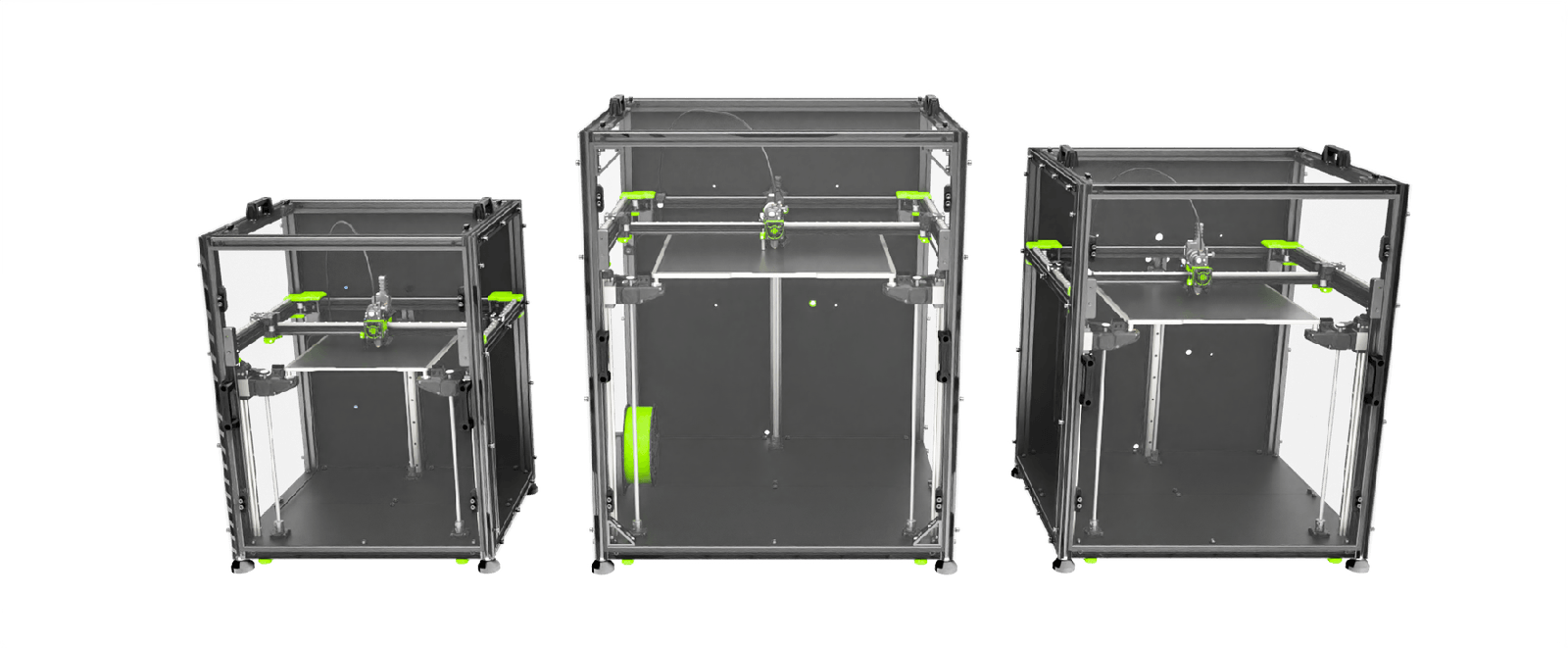
Choose a DIY printer or MMU, its size and a build tier.
Materials / Filaments
A material-first reference: standard, filled, nylon, flexible, high-performance and specialty filaments — pros, cons, TDS data and when to use each.
87 materials · 7 families
Nozzle and bed temperatures, drying schedules, whether it needs a hardened nozzle or a heated chamber, and what each one is actually good for. Values are representative — always confirm against the manufacturer’s TDS for your spool.
Higher = easier for beginners
Higher = stronger, stiffer parts
Higher = holds shape at higher temps
Higher = better long-term outdoor use
Higher = softer / more elastic
The default 3D printing material and the easiest to print: low temperature, minimal warping, no enclosure needed, prints beautifully on open-frame machines. Made from renewable feedstock and rigid with excellent detail reproduction. Its weaknesses are heat (softens around 55–60°C — a car dashboard kills it) and long-term creep under load. High-flow variants (e.g. PolySonic) are tuned for 300mm/s+ printing.
Impact-modified PLA: slightly lower tensile strength than regular PLA but several times the impact resistance, trading brittleness for ABS-like toughness while keeping PLA printability. The pragmatic upgrade for functional parts on open-frame printers.
Crystallization-optimized PLA that transforms after an oven anneal: heat-deflection jumps from ~55°C to as high as 150°C (GF version anneals with minimal shrinkage). Prints exactly like PLA, then gains genuine engineering heat resistance — a remarkable capability-per-effort ratio.
Chemically-foaming PLA: above ~230°C an activation agent expands the extrudate nearly 3×, letting you print at 40–60% flow for dramatically lighter parts. The RC aircraft community standard. Requires per-temperature flow calibration — foaming rate changes with temperature and speed.
PLA carrying 20–50% powdered wood, cork, chalk or real metal (bronze/copper/steel). Prints like slightly-fussy PLA but post-processes like the fill material: wood versions sand and stain; metal versions polish to a genuine metallic luster and take patinas; heavy fills give castings-like heft.
The workhorse between PLA and ABS: tougher and more heat-tolerant than PLA, far easier than ABS, with good chemical resistance and a slight flex that resists cracking. Prints on any machine with a heated bed. Its vices: stringing, gloopy first layers that weld to some bed surfaces, and scratches showing on the glossy finish.
PETG's tougher sibling: a copolyester with dramatically better impact strength (approaching polycarbonate in some grades), better clarity, and less stringing, at slightly higher print temperatures. Increasingly the "buy this instead of PETG" answer for demanding functional parts.
Straight PET (bottle plastic) is stiffer and stronger than PETG with better temperature resistance, but crystallizes — it needs higher temps, more care against warp, and rewards annealing. Mostly encountered as the base of PET-CF, but neat PET is a legitimate strong engineering material.
The classic engineering thermoplastic: tough, heat-resistant to ~95°C, machinable, and acetone-smoothable to injection-molded gloss. Demands an enclosure to prevent warping and layer splitting on anything bigger than a trinket. Printer parts (Voron ecosystem) are ABS almost by definition.
ABS re-engineered for the outdoors: the butadiene swapped for acrylate rubber, making it genuinely UV-stable — years outside without yellowing or embrittlement. Slightly easier to print than ABS with less odor. The default for anything living outside.
Dual-purpose: a light, matte, easily-sanded structural material in its own right, and the classic dissolvable support for ABS/ASA (dissolves in d-limonene while ABS survives). Print settings mirror ABS, making dual-extrusion pairing natural.
Prints like PLA, smooths like magic: isopropyl alcohol vapor melts the surface into glossy, layer-free finishes (PolySmooth), and the same chemistry burns out ash-free for investment casting (PolyCast) — print a pattern, dip/smooth it, cast real metal from it.
The "premium PETG" family: copolyesters tuned for higher temperature resistance (~80°C+), better toughness and cleaner printing than commodity PETG, while staying enclosure-free. A quiet workhorse category that punches above its modest fame.
Plexiglass in filament form: the stiffest and most optically clear common printable, weatherproof and hard-surfaced. Pays for it with brittleness and warp — treat it like a fussy ABS that rewards patience with glass-like parts.
The living-hinge chemical-resistance champion: nothing common attacks it, it never absorbs water, it fatigue-cycles nearly forever (flip-top caps are PP), and it floats. Also the worst bed-adhesion story in 3D printing — it sticks to nothing except itself, so you print on PP packing tape or dedicated sheets.
Glass fiber transforms floppy PP into a stiff, dimensionally-stable engineering material while keeping the chemical immunity and zero moisture uptake — and the fibers dramatically tame PP's warp. The automotive under-hood combination.
The bearing-and-gear plastic: unmatched slipperiness, fatigue life, and machinability — but genuinely hostile to print. It sticks to almost nothing (POM sheet or specific adhesives required), shrinks hard, and overheated POM releases formaldehyde. For those who need printed gears that actually last.
The material that melts in hot water: prints at temperatures other filaments consider "warm," and finished parts can be dunked in 60°C water and reshaped by hand, repeatedly. Used for medical splints, form-fitting grips, and printers for education (cool-touch extrusion).
Chopped carbon in PLA buys real stiffness, a gorgeous matte surface that hides layer lines, and near-zero warp — while keeping PLA temperatures. The gateway fiber-filled material and the easiest way to make prints look professionally molded.
The everyday functional-print upgrade: PETG toughness plus CF stiffness and a matte finish, with the stringing largely cured by the fibers. Arguably the best effort-to-result engineering filament for enclosureless printers. GF versions trade some stiffness for lower cost and more toughness.
The value high-performance composite: annealed PET-CF approaches filled-nylon stiffness and 200°C heat deflection without a heated-chamber printer or nylon's moisture drama (though drying is still essential). The material that made "PPA-CF performance on a hobbyist machine" plausible.
Glass-filled PET: 80–90% of PET-CF's performance at a lower price, with glass's typical gifts — more toughness than carbon, slightly less stiffness, no RF interference (glass is radio-transparent where CF is conductive).
ABS with the warp finally tamed: fibers cut shrinkage dramatically, making large ABS parts printable, stiffer, and matte-finished. GF versions favor toughness and price; CF favors stiffness and looks.
The outdoor composite: ASA's genuine UV immunity with fiber stiffness and reduced warp. What drone arms, roof fixtures, and vehicle exterior brackets want to be printed in.
The tough-part standard: nylon's wear resistance, fatigue life and impact strength make it the material for parts that get abused. Copolymer 6/66 grades tame the classic warp. The catch is water: nylon drinks humidity in hours, printing wet ruins it, and absorbed moisture post-print softens parts (sometimes usefully).
The dimensional nylon: absorbs a fraction of PA6's moisture, holds tolerances in service, warps less, and prints more politely — trading a little strength and temperature for a lot of predictability. What MJF/SLS parts are made of, now in filament.
The middle path: PA6-class mechanicals with meaningfully lower moisture uptake, partly bio-based feedstock, and better dimensional behavior. Increasingly the base for premium CF/ESD compounds for exactly those reasons.
The consumer strength king: the material Bambu made mainstream, combining nylon toughness with carbon stiffness into printed parts that replace machined brackets. Fibers nearly eliminate nylon's warp, making this genuinely easier to print than neat nylon — dry it and it behaves.
The industrial workhorse composite (most "glass-filled nylon" car parts are exactly this): slightly less stiff than PA6-CF but tougher, cheaper, RF-transparent, and nearly as heat-capable. The rational default for strong printed parts that don't need CF's bragging rights.
The precision composite: PA12's dimensional stability and low moisture uptake with carbon stiffness. Parts measure the same in January humidity and July humidity — the pick for fixtures and mechanisms where PA6-CF's moisture swell is unacceptable.
Nylon promoted to the high-performance league: an aromatic backbone adds stiffness and cuts moisture sensitivity vs PA6 (the big heat gains come in the CF/GF grades). The bridge between hobbyist nylons and the PEEK class — printable on good enthusiast machines.
Currently the strongest material printable outside a heated-chamber industrial machine: aluminum-adjacent stiffness-to-weight, ~200°C heat deflection, and moisture behavior civilized enough for real service. If a printed bracket must not fail, this is the modern answer.
The glass twin of PPA-CF: a touch less stiff, tougher on impact, kinder to the wallet, and RF-transparent. Everything said about PPA-CF applies with the standard glass-vs-carbon trade.
The default flexible: firm enough to print on any direct-drive machine at decent speed, soft enough for grips, gaskets, wheels and phone-case duty. Abrasion resistance embarrasses rigid plastics. High-flow variants (TPU95-HF) print at rigid-filament speeds.
Noticeably squishier than 95A: closer to a shoe-sole or squeegee feel. Printing demands patience — slow speeds, direct drive with a constrained filament path, and dialed retraction. The reward is genuinely soft functional parts.
Barely flexible — think ski-boot shell: prints almost like a rigid filament (even on some bowden setups) yet shrugs off impacts that shatter PLA and keeps abrasion resistance TPU is famous for. Underrated for "unbreakable" utility parts.
Active-foaming elastomers whose final hardness you tune with nozzle temperature: one spool spans roughly 60A–90A feel. Foamed parts feel like running-shoe midsoles — because that is precisely the industrial application (drop-in insoles, saddle pads, padding).
A newer oddity: glass fiber in an elastomer yields a semi-rigid, highly damped material — stiffer than any neat TPU while keeping rubber's toughness and grip. Think structural parts that must never shatter and should swallow vibration.
The athletic elastomer (Pebax is what premium running-shoe plates ride on): dramatically higher rebound/energy return than TPU, lighter, and keeps its springiness in the cold where TPU stiffens. The performance flexible for anything that bounces, springs, or flexes repeatedly.
The heat-resistant flexible: a copolyester elastomer that keeps working past 100°C where TPU gives up, with better chemical and UV resistance too. The pick for flexible parts near heat — ducts, under-hood boots, hot-liquid seals.
The impact king of common engineering plastics: safety-glasses-and-riot-shield chemistry with ~110–135°C heat deflection (grade-dependent). Real PC demands high temps and a warm chamber to avoid layer splitting; "easy" blends (ezPC-class) trade some performance for hobbyist-machine printability.
The automotive interior alloy: PC toughness moderated by ABS printability. Easier than straight PC, tougher and more heat-capable than straight ABS, with excellent surface finish. What dashboards and power-tool bodies are molded from.
Polycarbonate stiffened and warp-tamed by carbon: near-PC impact with composite rigidity and a matte surface. A strong all-rounder for hot, stiff, tough duty — the "one composite to rule the enclosure printer" for many users.
The chemical-warfare survivor: virtually nothing dissolves PPS below 200°C — fuels, acids, solvents, brake fluid all bounce off. Inherently flame-retardant (UL94 V-0 without additives) with 200°C+ service when crystallized. Demands true high-temp printing hardware.
PPS armored with fiber: the chemical immunity and V-0 rating plus composite stiffness and 240°C-class heat deflection. One of the most capable materials that consumer-adjacent high-temp machines (X1E-class, modified Vorons) can actually print.
The king of thermoplastics: aerospace/medical-implant grade with 240°C continuous service, near-universal chemical immunity, inherent V-0, steam-sterilizable, and strength rivaling some aluminum alloys by weight. Printing it properly requires machines built for it — 400°C+ hotends and genuinely hot chambers — plus crystallinity management (slow-cool or anneal for the real properties).
The ceiling of FFF material performance: fiber-reinforced PEEK approaches cast-metal territory for stiffness-critical hot parts. Also slightly kinder to print than neat PEEK (fibers moderate crystallization warp). If this can't do it, you need metal or autoclave composites.
PEEK's printable cousin: the amorphous-slow-crystallizing "A" copolymer prints with far better layer adhesion and less warp than PEEK, at somewhat lower temperatures, then can be annealed toward crystalline properties. The pragmatic aerospace choice (it's flying on actual spacecraft).
Carbon-reinforced PEKK: the most printable of the ultra-performance composites thanks to PEKK-A's forgiving crystallization, with ESD variants dominating semiconductor tooling. The realistic top-end for well-built enthusiast high-temp machines.
The certification king: ULTEM 1010 holds aerospace FST (flame/smoke/toxicity) certs, NSF food contact, and steam-autoclave endurance, with the highest strength and chemical resistance in the PEI family. The amber material of legitimate flight hardware. Amorphous — so no anneal games, but brutal chamber requirements.
The aircraft-interior ULTEM: a PEI-PC alloy trading some of 1010's heat and strength for dramatically better toughness and printability. THE certified material of commercial-aviation printed parts (Stratasys ecosystems), with GF/CF versions for stiffness.
The sterilization champion: PPSU laughs at steam autoclaves (1000+ cycles), boiling water, and harsh cleaners — it's what premium reusable medical instruments and aircraft plumbing are made of. The toughest of the sulfone family with the highest thermal capability.
The budget tier of the ultra-polymers (relatively speaking): PSU and PES deliver sulfone-family heat, hydrolysis resistance and autoclavability below PPSU's toughness and price. Common in membranes, food service, and electrical duty.
The printable fluoropolymer: a cousin of PTFE that actually extrudes, bringing near-Teflon chemical immunity (chlorine, bromine, acids, fuels), inherent V-0, UV/weather immunity measured in decades, and piezoelectric party tricks. Semiconductor and chemical-plant standard.
The quiet electrical-engineering classic (Noryl): light, dimensionally stable, nearly moisture-proof, hydrolysis-immune, with superb dielectric behavior across temperature. Prints hotter than ABS (~300°C) but well below the ultra-polymers — an underrated engineering sleeper for electrical and steam-adjacent duty.
Dissolves in plain tap water, enabling impossible geometries in dual-extrusion: internal channels, captive mechanisms, perfect overhang undersides. Pairs with PLA/PETG temperature-wise. Its curse: it drinks humidity so fast that spool management becomes a lifestyle.
PVA's better-behaved successor: dissolves several times faster, adheres to more materials (including some nylons), and tolerates nozzle heat a little longer before cooking. Costs more; worth it the day a PVA print fails from moisture.
Engineered to stick just enough: peels off cleanly by hand, leaving near-soluble-quality surfaces without water baths or drying paranoia. Family-matched grades exist from PLA all the way to PEI/ULTEM support (the industrial norm — even Stratasys uses breakaway at the top end).
Carbon-nanotube-loaded PETG tuned to the ESD-safe window (10^6–10^9 Ω surface resistance): dissipates static without being conductive, protecting sensitive electronics from both discharge and rapid charge bleed. The accessible entry to legitimate ESD tooling — jigs, trays, and fixtures for electronics work.
The ESD family's temperature step-up: ABS mechanicals and ~95°C capability with controlled static dissipation. The classic choice for electronics-manufacturing fixtures that ride through wave-solder-adjacent or warm process zones.
ESD protection that survives serious heat and impact: polycarbonate's toughness with dissipative loading, for fixtures near reflow processes, burn-in racks, or anywhere ESD-PETG would sag or crack.
Dissipative nylon: ESD control plus nylon wear resistance and toughness — the moving-parts member of the ESD family for gears, guides, and robot end-effectors handling sensitive components.
The semiconductor-fab tier: ESD-safe ULTEM and PEKK for wafer-handling fixtures, test sockets, and process tooling that faces both extreme cleanliness/temperature demands and absolute static control. Industrial machines only — but nothing else does this job.
Actually conductive (10²–10⁴ Ω·cm class — far below the ESD window): enough for touch sensors, capacitive interfaces, LED circuits at low current, and EMI gasketing experiments. Not a wire replacement — resistance is high and current capacity tiny — but a genuine circuit-adjacent prototyping material.
Heavily-loaded compounds engineered to attenuate electromagnetic interference — printable Faraday enclosures for RF-noisy electronics, EMC pre-compliance experiments, and shielded sensor housings without machined aluminum.
Base engineering polymers (ABS, PC, PC-ABS, PA, PC) compounded to self-extinguish per UL94 V-0 — the requirement for enclosures around mains electronics, batteries, and transit/aerospace interiors. Print like their base resin; certify the assembly, not just the spool.
PLA loaded with iron powder: not a magnet itself, but ferromagnetic — magnets grab prints firmly. Bonus party trick: it genuinely rusts with salt water for authentic aged-iron props.
Highly-loaded metal powder in a printable binder: print a "green" part on a normal printer, then debind-and-sinter (through services like BASF's partners, or kiln programs for Filamet) into ~96%-dense REAL stainless steel, copper, or bronze. FFF as the front-end of metallurgy — with ~16–20% predictable shrinkage to design around.
The ceramic sibling of metal-sinter systems: print a bound zirconia or alumina green part, then kiln-sinter into true technical ceramic — 1000°C+ service, extreme hardness, electrical insulation, chemical immunity. Kiln access and shrinkage management required; capability unavailable any other way at this budget.
A PLA-based compound with specialty additives engineered to drill, saw, and screw like bone — radio-opaque under X-ray/CT imaging. Built for surgical rehearsal, med-device testing, and teaching without cadaver logistics.
Not a part material: a scrubbing compound engineered to grab residue and pigment out of nozzles and melt zones across a huge temperature window. The 30-second insurance policy between carbon-filled and pristine-white jobs, and step one of clog exorcisms (cold pulls love it).
The distinct CF grade built on PA612 (a PA6/PA12 copolymer) rather than the PA6 or PA12 backbones used elsewhere in this list: Polymaker's Fiberon PA612-CF15 carries 15% carbon fiber and lands between PA6-CF and PA12-CF on moisture uptake, while beating both on printability — it's tuned for open, cool beds (25–50°C) and moderate speeds without a heated chamber.
A structurally distinct ABS composite, not just a renamed ABS-CF: fiber is concentrated in the filament's core rather than distributed evenly through the strand, at a higher 20% loading than typical 10% chopped-CF ABS. The core-shell design reduces direct fiber-nozzle contact (extending nozzle life despite the higher loading) and improves Z-axis layer bonding versus conventional ABS-CF, while supporting print speeds up to 200mm/s.
A genuinely distinct chemistry from TPU: SEBS (styrene-ethylene-butylene-styrene) block-copolymer elastomer rather than a polyurethane. Verified as a real, separately-sold product (Jabil TPE-SEBS 1300 85A) — not a rebrand of TPU. Note: many retailers mislabel TPU spools (e.g. NinjaFlex) as "TPE" for SEO even though NinjaFlex is confirmed polyurethane chemistry; this entry is the actual SEBS-based material. Prints noticeably easier than TPU — no drying needed, works on Bowden setups, no heated bed required — at the cost of lower fatigue/oil resistance than TPU.
A meaningfully different filler chemistry from the carbon/glass-filled ABS entries already covered: chopped aramid (Kevlar) fiber instead of carbon or glass. Aramid trades outright stiffness for abrasion resistance and toughness — Kevlar fibers don't snap the way carbon does, so impact/fatigue behavior differs from ABS-CF/GF even though tensile numbers are lower on paper.
The semi-crystalline counterpart to the amorphous PEKK-A already covered: crystallization happens during printing itself rather than requiring a post-anneal, delivering up to 260°C continuous-use capability once fully crystallized — meaningfully higher service temperature than PEKK-A's as-printed state. Trades PEKK-A's easier layer adhesion for greater in-service heat resistance.
A distinct PA6/69 copolymer alloy (not PA6, not PA6/66 CoPA, not PA12) purpose-engineered by taulman3D to combine copolyester-rivaling tensile strength with nylon's durability and unusually low water absorption for a nylon. The HDT variant anneals to 180°C service — a meaningfully different profile from the generic PA6/66 CoPA entry already in the catalog.
Real, commercially available tungsten-loaded FFF filament confirmed from two independent verified suppliers (The Virtual Foundry's Rapid 3DShield Tungsten at 91–93% metal loading, and Prusa's Prusament PETG Tungsten 75%). Unlike the sinterable metal filament already in this catalog, this is NOT debound/sintered afterward — it's used as-printed for its density and attenuation properties. Tungsten's higher density than lead with no lead toxicity makes it attractive for radiation shielding, ballast, ND testing, and counterweight applications directly off the printer.
TPE is the umbrella term for every rubbery thermoplastic, so a spool labelled "TPE" can be one of two things. Some are a genuinely different base polymer: Fillamentum's Flexfill TPE 90A is a polyolefin elastomer (90 Shore A) whose selling point is chemical resistance and very low gas permeability, and SEBS-based TPE is covered in its own entry. Many others are simply TPU sold under the broader name. Check the datasheet's polymer base: if it says polyurethane, print it as TPU. A polyolefin TPE prints slowly (Fillamentum specifies 15–25 mm/s), sticks poorly to bare PEI, and needs a PP-type adhesive and a brim.
PLA reformulated for fast CoreXY printers. Vendors lower the melt viscosity (eSUN describes it as balancing the molecular weight for high fluidity and low specific heat) so the filament melts fully at high volumetric flow and sets quickly once out of the nozzle. eSUN rates ePLA-HS for about 350 mm/s against about 50 mm/s for its standard PLA. On a slow printer it behaves like ordinary PLA; the difference only shows when the hotend's melt capacity becomes the limit.
PLA with additives that give a glossy, metallic sheen. Generic silk PLA has a reputation for brittleness, clogging, weak layers and losing its shine when printed fast. Polymaker says its reformulated Panchroma Silk fixes these and keeps its gloss up to 150 mm/s, and recommends printing glossy materials slower in general, because pushing them fast makes them look matte. Treat silk as a cosmetic material: slow the outer walls, and don't expect standard-PLA strength.
PLA with a matting filler that scatters light and gives a flat, non-reflective surface. Layer lines are much less visible and paint takes well. Polymaker rates Panchroma Matte for up to 300 mm/s and 24 mm³/s. The filler makes it slightly abrasive: Polymaker says that's not enough to require a hardened nozzle, but heavy users may want one for longevity. The filler also makes it a little more brittle than standard PLA.
PLA loaded with phosphorescent pigment that charges under light and glows in the dark. The pigment is hard and very abrasive: Polymaker says a hardened nozzle is required for glow materials, and that care is needed with AMS-style feeders too. A 0.4 mm nozzle is fine. Glow strength scales with wall thickness and infill, because thin walls hold little pigment and glow faintly.
The outdoor-grade counterpart to LW-PLA. A foaming agent expands the extrudate as nozzle temperature rises: colorFabb says it starts foaming at 240°C and foams more at 260°C, expanding up to about 2.5× its volume. You print at reduced flow to match (Bambu specifies a 0.45–0.80 flow ratio for ASA Aero), so parts come out at half to three-quarters of solid ASA's density, while keeping ASA's UV stability and higher heat resistance. Like LW-PLA, it needs per-spool calibration of temperature against flow.
A polycarbonate blended with PBT (a polyester) to add chemical resistance and cold-weather toughness. Polymaker's datasheet shows notched Charpy impact of 33 kJ/m² at room temperature and 15.7 kJ/m² still retained at −30°C, with good resistance to weak acids, oils and grease but poor resistance to strong acids and alkalis. It prints slowly (30–50 mm/s, fan off), and Polymaker recommends annealing right after printing to release internal stress.
A bio-polyester made by bacteria fermenting sugars and oils, not a PLA blend. colorFabb markets allPHA as breaking down in any environment without leaving microplastics, whereas PLA needs industrial composting. How fast it breaks down depends on part thickness, heat, moisture and microbial activity, and colorFabb doesn't publish timelines. It prints at PLA-like temperatures (190–200°C at 40–80 mm/s, full fan) on a cold bed with adhesive, and colorFabb lists heat resistance above 120°C.
Nylon 11 filled with carbon fiber. PA11 is made from castor oil rather than petroleum and, like PA12, absorbs far less moisture than PA6 (Prusa measures 0.5% after 7 days). Prusament's datasheet gives an HDT of 192°C at 0.45 MPa and 152°C at 1.8 MPa, and recommends 20% part-cooling fan with a brim for larger objects. A hardened nozzle is required.